In 2024 the Essential Services Commission rejected 18,238 Victorian energy efficiency certificates in a single enforcement action against nine businesses. Not because the installations were bad. Because the businesses couldn’t produce the installation, evidentiary and record-keeping documentation the program requires.
One had its accreditation suspended. Another had conditions imposed and was banned from the activity entirely. Seven got formal warnings.
Those certificates were revenue. Work already done, equipment already installed, customers already discounted. All of it written off because the paperwork behind it didn’t hold up.
That’s the thing about rebate admin that quotes and spreadsheets never quite capture. It isn’t overhead attached to the money. It is the money.
Why VEU admin is heavier than it looks
Every accredited person under the Victorian Energy Upgrades program carries a set of obligations that have very little to do with installing equipment.
You keep records substantiating every activity and every certificate created from it, and you keep them for six years after the certificates are made. When you apply for accreditation, and again during audits, you have to demonstrate that your record-keeping arrangements are reliable and accurate. Since 1 July 2024, you also fund an independent assurance audit at least once every two years.
Then there’s the scheme participant register: every installer and designer working under your accreditation has to be registered and kept current, with files on record evidencing their credentials. There’s a code of conduct governing how consumers are engaged. Consumer complaints have clocks on them: acknowledge within five business days, resolve within twenty.
None of this is optional, and none of it happens on the tools. It happens afterwards, on a laptop, usually at night.
The spreadsheet stage
Almost every rebate business starts the same way. A spreadsheet with a row per job. Columns for the customer, the address, the equipment, the serial number, the install date, the installer, the evidence photos, the certificate number, whether it’s been submitted, whether it’s been paid.
For a while this works fine. At ten claims a month you can hold the whole thing in your head and the spreadsheet is really just a memory aid.
The trouble starts when the volume climbs and the data has to live in two places at once. The customer and the equipment are already in your job management system, because that’s where the job was scheduled and invoiced. That system is doing the real work, and what an HVAC business actually needs from it is a longer list than most platforms assume. Now they’re in the rebate spreadsheet too, typed in a second time by a person reading off a screen.
Every one of those re-keyings is a chance for the serial number to lose a digit.
And when that catches up with you, it doesn’t show up as slow admin. It shows up as a rejected claim, months later, on a job you finished and forgot about.
What actually breaks
Talk to anyone running rebate volume and the same problems come up.
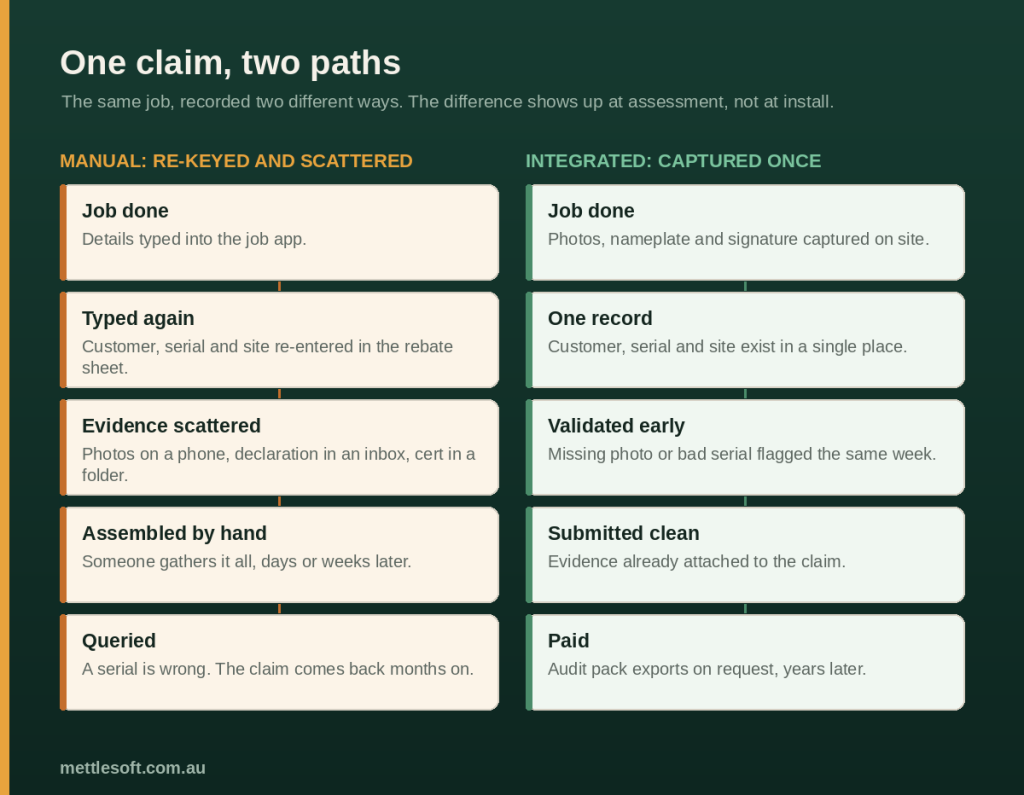
Evidence that isn’t where it should be. The install photo is on a technician’s phone. The signed customer declaration is in someone’s email. The compliance certificate is a scan in a folder named scans_new_2. Each piece exists. Producing all of them together, for one job, eighteen months later, takes an afternoon.
Data entered more than once. Customer details in the job app, then again in the rebate tracker, then again in the registry submission. Three chances to introduce an error into a number nobody will check until it’s rejected.
No visibility on claim status. Which claims are submitted? Which are pending? Which came back for more evidence and are sitting in an inbox nobody’s watching? If answering that takes more than a few seconds, claims are leaking.
Eligibility rules that shift under you. Product register changes, activity specification updates, co-payment thresholds. A quote built on last quarter’s rules is a quote you may not be able to honour.
Nobody knows the real margin. The rebate is revenue, but the admin behind it is cost, and almost nobody tracks the hours. Which means the claim volume that looks most profitable might be the one quietly consuming the most labour.
The 30 September deadline is a live example
Here’s what this looks like right now, not in theory.
From 30 September 2026, the minimum customer co-payment on VEU air conditioning upgrades rises to $3,000 including GST for any ducted reverse-cycle system and for multi-split systems of 10kW or more. Systems under 10kW stay at $1,000. There’s also a new cap on the incentives large multi-split systems can generate, aimed at discouraging oversizing.
Now think about what that means operationally for a business with jobs in the pipeline.
Every quote sitting unsigned needs checking against its install date. Every multi-split quote needs re-running against the new cap. Anything scheduled near the change date needs a decision about which side of it the job lands on, and the customer needs telling. Your team needs to know the new thresholds cold, because a co-payment quoted wrong is a co-payment you eat.
If your pipeline lives in a spreadsheet, that’s a manual review of every open quote, done by hand, under time pressure, while the phone keeps ringing with people trying to beat the deadline.
If your pipeline lives in a system that knows each job’s install date, capacity and activity type, it’s a filtered list.
This is the operational side of a program that now runs to 2045. We’ve written about what the VEU extension means for HVAC providers, including the 2025 changes that tightened the paperwork: mandatory five-year warranties, co-payments, and stronger ESC enforcement powers with penalties for false or misleading information.
That gap is the whole argument of this post.
What automating it actually means
Nobody is suggesting software submits your claims and you stop thinking about compliance. Automating rebate admin means removing the re-keying, the chasing and the searching, so the judgement calls are the only part left doing by hand.
In practice:
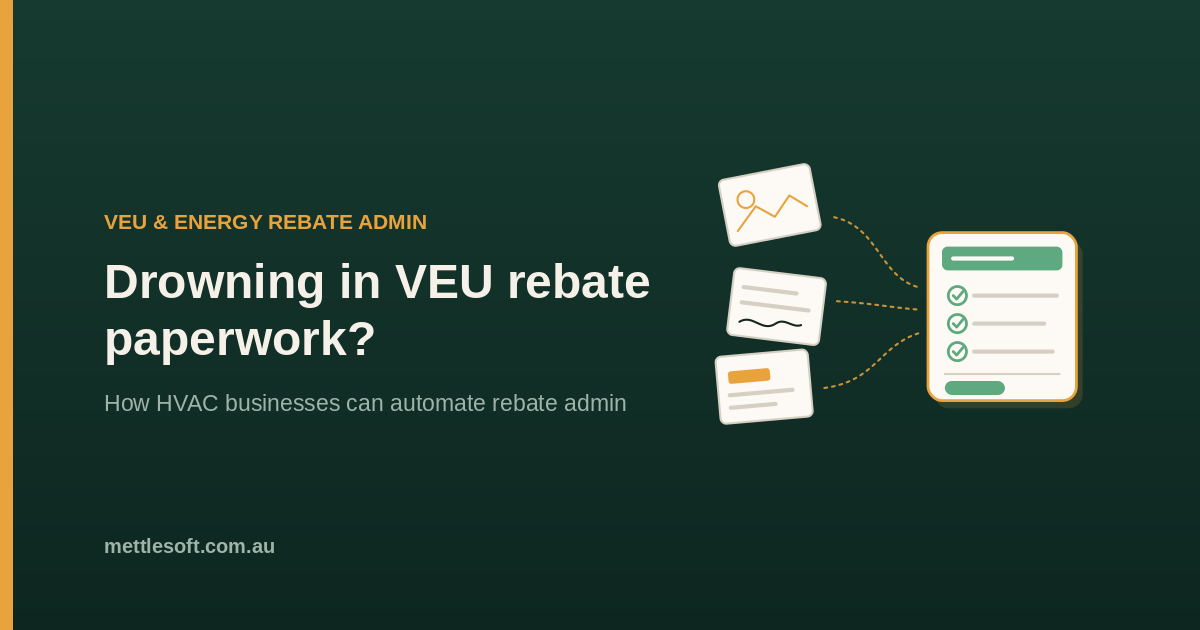
Capture the evidence once, at the job. The technician photographs the install, the nameplate and the decommissioned unit inside the job record, on site, while standing in front of it. The customer signs the declaration on the same screen. Nothing gets emailed anywhere. Nothing needs collecting later.
One record, not three. Customer, site, equipment and serial exist in exactly one place and flow into the claim. If it’s right in the job, it’s right in the claim, because they’re the same data.
Validate before submission, not after. The system checks the obvious failure conditions while the job is still fresh: photo missing, serial malformed, product not on the register, co-payment below the current threshold for that capacity. Catching it the same week is a five-minute fix. Catching it at assessment is a rejected certificate.
A claim pipeline you can see. Draft, ready, submitted, queried, approved, paid. Sorted by age. The claim sitting at “queried” for three weeks should be impossible to miss.
Audit packs that assemble themselves. When the ESC asks for the file on a job from two years ago, it’s a single export: evidence, declaration, installer credentials, certificate reference. Not an afternoon of archaeology across a phone, an inbox and a shared drive.
When it’s worth building something
The honest answer is that it depends on volume, and plenty of businesses aren’t there yet.
At low claim volume with one person handling it, a well-organised spreadsheet and a disciplined folder structure will hold. The cost of building beats the cost of the problem, and you should stay where you are.
The maths turns somewhere else. When claim volume is high enough that someone is effectively doing full-time data entry. When rejections and re-submissions stop being exceptions and become a normal part of the month. When rebate work is a real share of revenue and you still can’t see the pipeline. The two-year independent audit is worth noticing too, because it’s an external test of exactly the record-keeping that manual processes handle worst.
The tell is the same one that shows up everywhere in this business: there’s a person whose actual job has become moving information between systems that were each supposed to save time. We built for a Melbourne HVAC contractor sitting exactly there. Their admin workload had grown to about seven days a month. It now runs at two.
Where to start
You don’t need a platform to make this better. You need to know where the leak is.
Pick your last twenty claims. For each one, note how long it took from job completion to submission, whether it was queried, and how many places you had to visit to assemble the evidence. Twenty rows will tell you more than any vendor demo.
If most claims go out inside a week and few come back, your process is working. Leave it alone.
If the number that jumps out is how many places you had to look, that’s an integration problem, and it’s the one that compounds fastest as volume grows.
We build custom software for HVAC and trades businesses in Australia, including rebate management systems, and we’d rather tell you your spreadsheet is fine than sell you something you don’t need. If you want a second opinion on whether your rebate admin is at that point, get in touch.