A commercial building is a collection of systems that mostly don’t talk to each other. The chillers run on one controller. The air handling units run on another. Lighting is on timers someone set in 2019. The solar array does its own thing. Each one is doing what it was told, and none of them knows what the others are doing.
The energy bill is the sum of those disagreements.
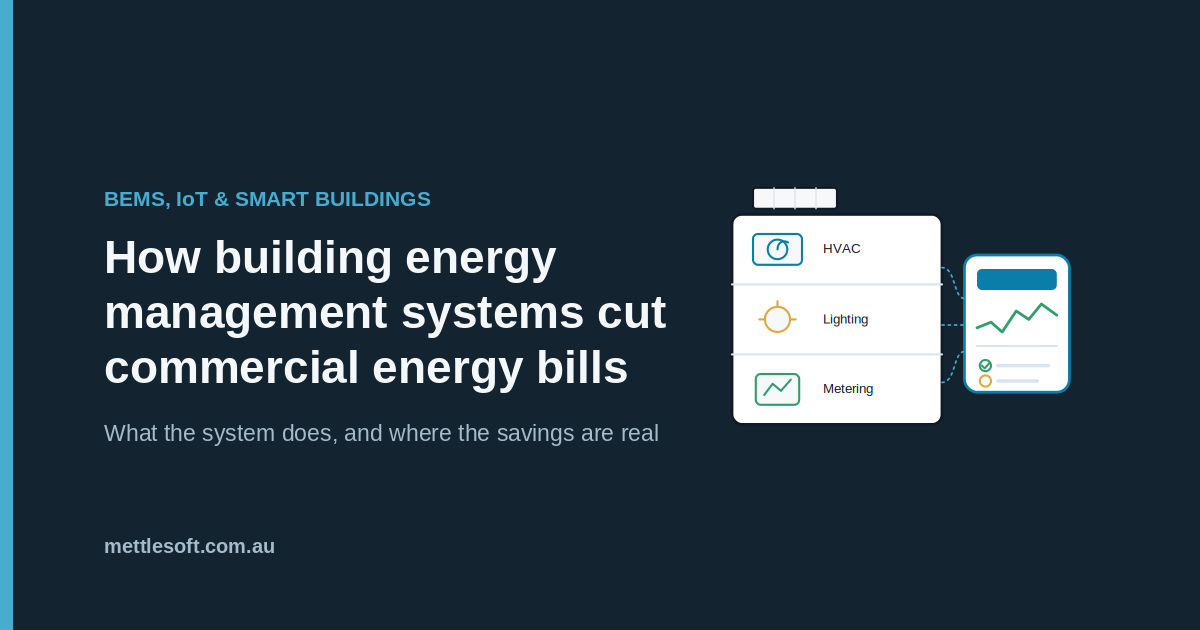
That’s the gap a building energy management system is built to close. Not by replacing any of that equipment, but by sitting above it, watching all of it at once, and making the pieces act like parts of one building instead of a dozen strangers sharing a roof.
What a BEMS actually is
Strip away the acronyms and a building energy management system is two things: a way to see energy as it’s being used, and a way to act on what you see.
The seeing part is metering and sensors feeding a live picture of consumption, broken down far enough that you can tell the third-floor air handling unit from the basement pumps. The acting part is control: schedules, setpoints and automated responses that adjust equipment based on what’s actually happening in the building rather than what someone assumed when they set it up.
Worth clearing up one point of confusion. A building management system (BMS) runs the equipment. A building energy management system is focused on the energy that equipment consumes, and often layers over an existing BMS rather than replacing it. Plenty of buildings have a BMS that keeps everything running and still have no real idea where their energy goes. The two aren’t the same job.
If you’re newer to the concept, we’ve covered what a BEMS is and how it works from the ground up. This post picks up where that one leaves off.
Where the savings actually come from
Efficiency marketing likes to imply the software is the saving. It isn’t. The software just makes visible, and then fixable, a handful of things that quietly waste money in most commercial buildings.
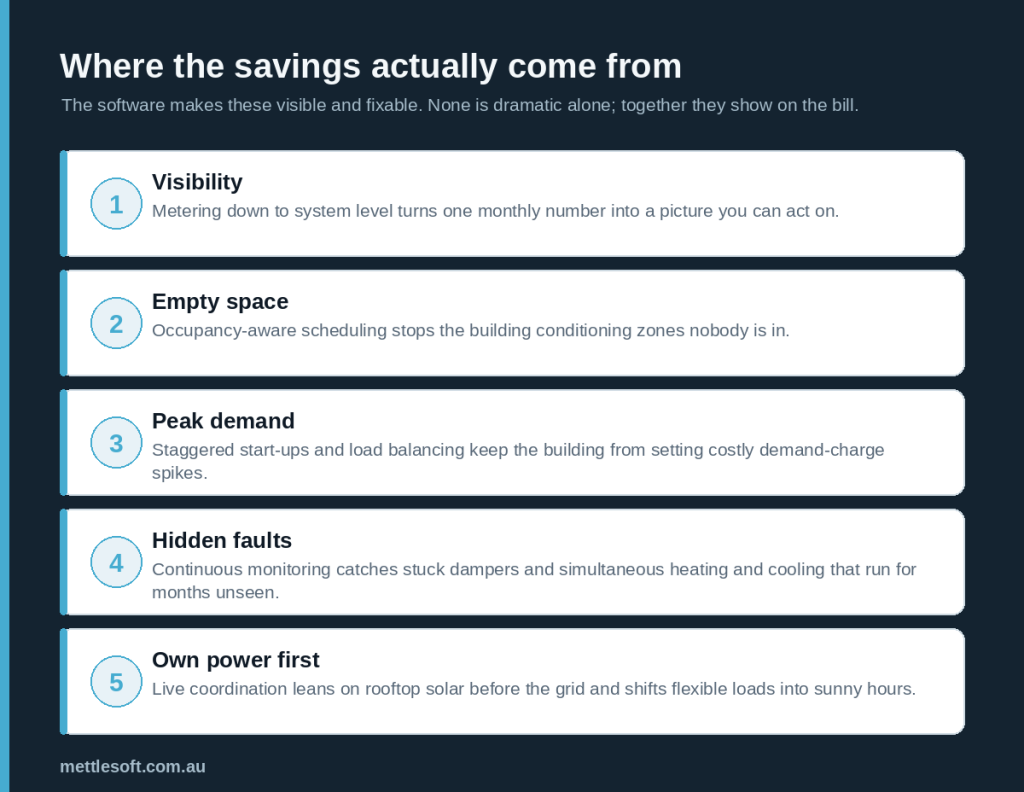
You can’t cut what you can’t see. This sounds obvious and it’s the biggest one. A building that gets a single monthly bill has almost no information. A building metered down to the system level can answer questions like why consumption barely drops overnight, or which floor is running at full tilt on a public holiday. Most of the early savings from a BEMS aren’t clever automation. They’re someone finally being able to see an obvious problem.
Conditioning space nobody’s in. Heating and cooling empty rooms is the most common waste there is. Occupancy-aware scheduling and setpoint control means the building winds plant back when a zone is empty and has it comfortable by the time people arrive. Not complicated. Just very hard to do by hand across a building with thirty zones and shifting patterns of use.
Peak demand. Many Australian commercial electricity tariffs charge not just for the energy you use but for your highest spike in demand across the billing period. One bad afternoon where every system ramps at once can set a demand charge you then pay against for months. A BEMS can stagger start-ups and balance loads so the building doesn’t create those spikes in the first place. It’s one of the most misunderstood lines on a commercial bill, and one of the easiest to actually do something about once you can see it forming.
Faults that hide. A damper stuck open. A zone heating and cooling at the same time because two controllers are fighting. A pump running 24/7 that was only ever meant to run in occupied hours. These faults don’t announce themselves. They just show up as a bill that’s higher than it should be, and they can run for months before anyone notices. Continuous monitoring catches the pattern that a person glancing at a gauge never would.
Using your own power first. If there’s solar on the roof, the building should be leaning on it before it draws from the grid, and shifting flexible loads into the hours when the panels are producing. Coordinating that in real time, against live generation and live consumption, is exactly the kind of decision software makes well and people make badly.
None of these is dramatic on its own. Together, across a building where HVAC alone can be the largest single load, small percentages off a big number add up to something that shows on the bill.
The part that only matters in Australia
There’s a second reason commercial operators here care about this, and it isn’t the bill.
NABERS, the National Australian Built Environment Rating System, rates commercial buildings from one to six stars on their actual measured energy performance over twelve months. Not design predictions. What the building really did. And the rating carries commercial weight: under the Commercial Building Disclosure program, offices of 1,000 square metres or more have to disclose a current NABERS Energy rating when they’re sold or leased, and it has to appear in the advertising. Government tenants generally require a minimum 4.5 stars. A federal roadmap released in late 2025 is set to extend mandatory disclosure beyond offices to other building types by 2030.
So the rating is tied to leaseability, to rent, and to property value, not just to running costs. NABERS’ own published figures put the average energy saving across rated Australian offices at around 42% over fourteen years, which tells you how much slack sat in these buildings before anyone measured properly.
Here’s the connection. NABERS rewards operational performance measured from real data. A BEMS is the thing that produces that data continuously and gives you the levers to improve it between assessments, rather than scrambling in the month before a rating is due. Efficiency you can see is efficiency you can prove.
The real problem: none of it talks
Everything above assumes the systems in a building can be read and controlled from one place. In practice, that’s the hard part, and it’s where most of the actual work lives.
A typical commercial building has equipment from different manufacturers, bought in different decades, speaking different protocols. The chiller doesn’t share a language with the lighting. The solar inverter has its own app. Newer gear talks happily over modern protocols. Older gear needs coaxing, and every building has some. A BEMS is only as good as its ability to pull all of that into one coherent picture and push instructions back out to each piece in a language it understands.
That integration layer is genuinely difficult, and it’s why off-the-shelf rarely fits a building of any complexity cleanly. The monitoring dashboard is the easy, visible part. Getting fifteen kinds of equipment to report reliably into it, and to respond to it, is the engineering.
This is the work we do. We built the software platform behind Retragreen’s building energy management system, which pulls live data off IoT-connected devices over MQTT, balances loads across heating, cooling, lighting and solar, and presents the whole building as an interactive real-time model rather than a wall of numbers. The dashboard is what people notice. The integration underneath it is what makes the savings real.
Is it worth it for your building?
Honestly, not always.
A single small building on a simple tariff, low consumption, one or two systems, probably doesn’t have enough waste in it to justify the investment. The savings are real but the base is small, and a well-configured off-the-shelf monitoring tool may be all it needs.
The maths changes when the building gets bigger or there are several of them. High consumption, complex HVAC, multiple zones, a demand charge doing real damage, solar that isn’t being used well, or leasing pressure that makes a NABERS rating worth money. When two or three of those are true, the case for proper energy management, and usually for a platform built around how your buildings actually run, gets strong quickly.
The tell is the same as it is with most things: when nobody in the organisation can actually answer where the energy is going, the building is almost certainly spending more than it needs to. You just can’t see it yet.
If you’re weighing that up for a commercial building or a portfolio and want a straight answer on whether it’s worth doing, get in touch. We’re comfortable telling people their building is simple enough that they don’t need us.