There’s a moment most growing businesses reach sooner or later. You’re paying every month for software that does about 80% of what you need. The other 20% you’ve patched over with a spreadsheet, a couple of manual steps, and a workaround nobody wants to explain to the new hire. Then someone in a meeting asks the obvious thing: why don’t we just build our own?
It’s a fair question. It’s also usually asked at the wrong time, for the wrong reasons. And the answer matters more than people expect. Get it right and you claw back hours every week, and money you didn’t realise you were leaking. Get it wrong and you’ve sunk six figures into a system that does roughly what a $90-a-month subscription already did.
So before you commit to either camp, it’s worth being honest about what off-the-shelf vs custom software actually trades off, and where the line sits for a business your size.
What we mean by off-the-shelf and custom
Off-the-shelf software is the stuff you subscribe to. Xero for the books, ServiceM8 for the jobs, Shopify for the store. Someone else built it, thousands of businesses run on it, and you rent access.
Custom software is built for your business specifically. You own it, it does what you ask, and nobody else has the same thing.
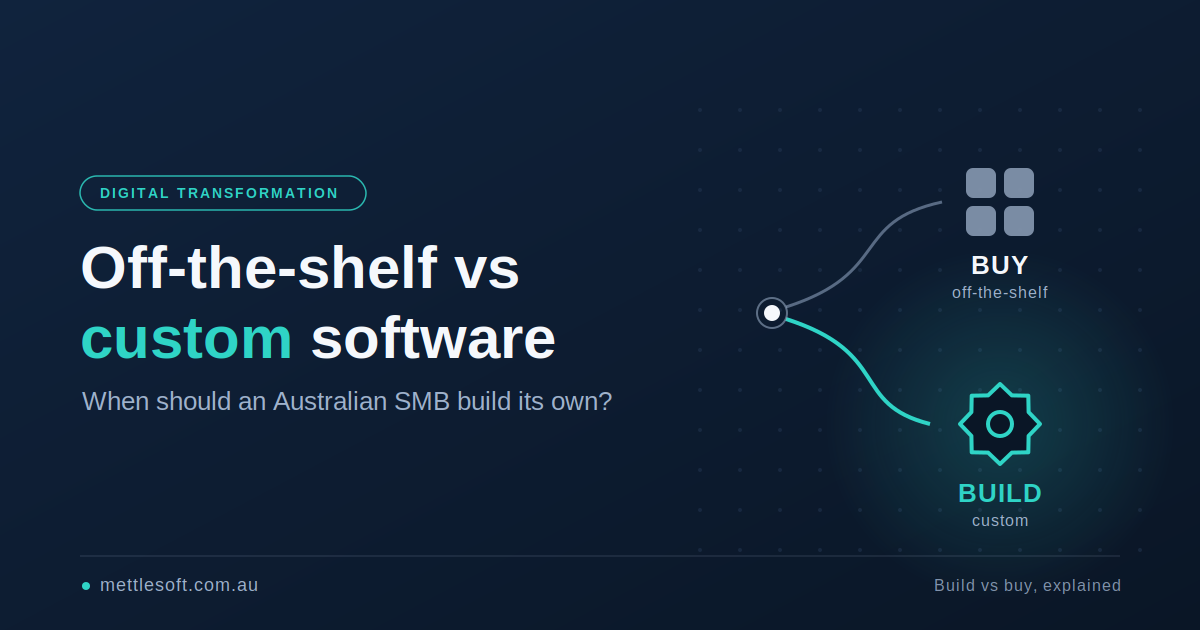
Most real setups end up somewhere between the two, which we’ll get to. But the trade-off underneath the whole decision is simple. Off-the-shelf gives you speed and a low upfront cost in exchange for fitting your business into someone else’s mould. Custom gives you a fit made to measure in exchange for time, money, and the responsibility of owning it.
Start here: off-the-shelf usually wins
Here’s the part most agencies won’t lead with, because we’d rather sell you a build. For most jobs, most of the time, you should buy, not build.
A subscription tool is cheap to start, it’s live this afternoon, and it’s maintained by someone whose whole business is keeping it running. It’s been tested by tens of thousands of users who already hit the bugs you’d otherwise find yourself. The integrations you need mostly already exist. If a $50-a-month tool does the job, building your own version of it is almost always a bad trade.
The rule of thumb: don’t build what you can buy. Reach for custom only when buying stops working, and be sure you can tell the difference.
The signs off-the-shelf is costing you more than it saves
So how do you know when buying has stopped working? It’s rarely one dramatic failure. It’s a slow accumulation of friction you’ve stopped noticing. A few signs worth watching:
You’ve reshaped how you work to suit the software. Every off-the-shelf tool has an opinion about how you should run your business. When the tool’s way and your way line up, great. When they don’t, you quietly rearrange your business to keep the software happy. This is the trap operators fall into with the big field service platforms. The product decides how a job should flow, and after a while you’re running your business the way ServiceM8 or simPRO wants you to, not the way that suits your crew.
The workarounds have workarounds. You export to a spreadsheet, reshape the data by hand, then import it into a second system that won’t talk to the first. Someone on your team spends Friday afternoons doing this. That afternoon is a running cost, it’s just hidden in a wage instead of an invoice.
You’re paying per seat for people who barely log in. Per-user pricing is fair when everyone’s a heavy user. It starts to hurt once you’ve got 40 staff and half of them open the thing twice a week.
The integration you need doesn’t exist, so the data gets carried across by hand, which means it’s late and sometimes wrong.
The admin specific to your trade isn’t handled at all. A Victorian HVAC business dealing with VEU rebate paperwork is a good example. The certificates, the customer co-payments, the compliance records, the evidence trail the ESC expects: no generic job app was built for any of that, so it lands back in spreadsheets and someone’s memory. (And with the Victorian Energy Upgrades program now extended to 2045, that admin isn’t going away any time soon.)
None of these on their own means you should build something. Together, they mean the tool you bought to save time has started charging you time back.
When building your own actually makes sense
Custom earns its place in a narrow set of situations. The clearest ones:
The software is your edge, not your plumbing. If the specific way you do the work is part of why customers choose you, renting a generic version of it hands that advantage back to every competitor using the same app. You want to own the thing that makes you different.
Your workflow is genuinely unusual. Not “we like doing it our way,” but structurally different from how the off-the-shelf tools assume the job works. If every product on the market makes you fight it, the market might not have built for your case yet.
Integration is the actual problem. Sometimes you don’t need a better tool. You need your five decent tools to stop living on separate islands. A custom layer that stitches them together can be worth more than replacing any one of them.
The per-seat maths has flipped. At three users, SaaS is a bargain. At sixty, those monthly seats can add up past what it would cost to own something outright. It’s worth running that number rather than assuming subscriptions are always cheaper.
A quick test before you spend anything
When you’re not sure, sort the decision into core and context. Build the parts that are core to why you win. Buy the context, the commodity plumbing every business needs. Nobody should be building their own accounting software or email.
Four questions get you most of the way there:
- Is this the thing customers actually pay us for, or the machinery behind it?
- Have we honestly tried to make an existing tool fit, or did we jump straight to “build”?
- What is the current workaround costing us over a year, counted in hours and mistakes, not just dollars?
- Could we start with the smallest useful version instead of the whole thing?
If the honest answers point at “this is core, we’ve tried to buy our way out, the workaround is expensive, and we can start small,” that’s when a build starts to make sense.
You don’t have to choose one side
The framing of “off-the-shelf vs custom” makes it sound like a fork in the road. For most businesses it isn’t. The sensible answer is usually both.
Keep Xero. Keep the tools that already earn their keep. Build the one piece that’s yours, and wire it into everything else with integrations. Start with the painful 20% rather than tearing out the 80% that works. A custom build doesn’t have to mean starting from a blank screen. Often it means adding the missing piece and connecting what you already run.
What changes the maths in Australia
The trades software market here is crowded and, to its credit, partly home-grown. ServiceM8, simPRO, and AroFlo are all Australian-built and good at what they do. But good for the average operator isn’t the same as good for yours, and “everyone in my trade uses it” is a reason to look closely, not a reason to stop thinking.
Support and time zones are easy to underrate. When your workday runs while an overseas vendor’s support team is asleep, a small outage can eat a whole morning.
Where your data lives is a real question under the Australian Privacy Act, especially if you’re holding customer records or anything tied to government rebate schemes.
And subscription creep is quietly brutal right now. Australian SMBs are carrying more software than ever, often without anyone adding up the total. It’s worth doing that sum before you decide custom is the expensive option.
So which should you choose?
If an off-the-shelf tool fits your business, use it and don’t look back. Buying is the right call more often than not, and there’s no prize for building something you could have rented.
But if you’ve started bending your business to suit the software, if the spreadsheets are multiplying, if you’re paying for seats nobody uses, or if the admin that’s specific to your trade simply isn’t handled, that’s when custom stops being an indulgence and starts being the cheaper option over time. And you can get there in stages, without betting the business on a rebuild.
At Mettlesoft we build custom software for Australian trades and SMBs, and we’re happy to give you an honest read on whether you actually need it. Sometimes the answer is “keep your subscription,” and we’ll say so. If you’d rather have that conversation than keep guessing, get in touch and we’ll talk it through.